
VERBEX Nurse Call System in Bangladesh – Smart Patient Calling Solution for Hospitals & Clinics
Modern healthcare facilities need fast, reliable communication between patients and medical staff. In hospitals, clinics, nursing homes, rehabilitation centers, and elderly-care facilities, even a short delay in communication can create operational problems.
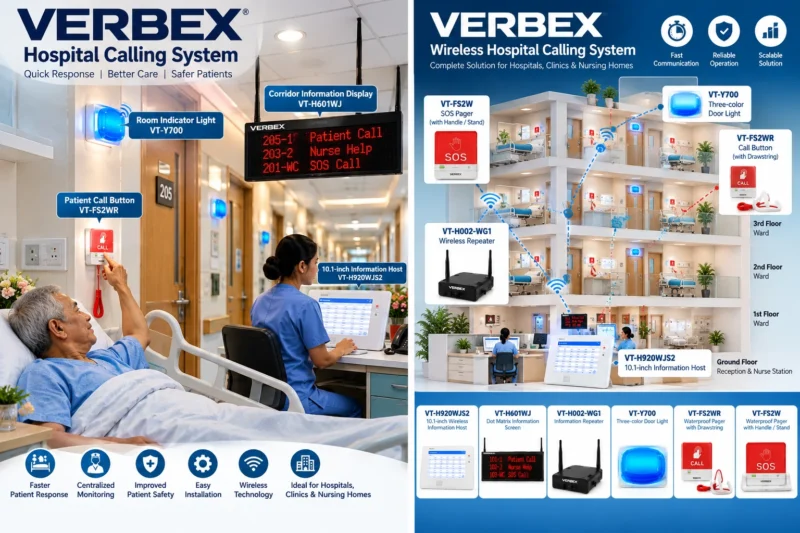
The VERBEX Wireless Nurse Call System is designed to provide a simple and effective way for patients to request assistance from nurses or caregivers. Using wireless call buttons, SOS units, corridor displays, room indicator lights, repeaters, and a central information host, healthcare facilities can build a complete patient-calling network without depending only on traditional manual methods.
For hospitals and clinics in Bangladesh, this type of system can be especially useful in patient wards, cabins, bathrooms, disabled toilets, elderly-care rooms, and long corridors.
What Is a Wireless Nurse Call System?
A wireless nurse call system allows a patient to press a call button or SOS switch when assistance is needed.
The signal is transmitted wirelessly to the nurse station or central monitoring point. Depending on the installation, the same call can also appear on a corridor information screen or activate a room indicator light.
A typical VERBEX system can work like this:
Patient presses CALL button → Wireless signal is transmitted → Repeater extends the signal if needed → Central host receives the call → Corridor display and room indicator show the alert → Nurse responds
This creates a clear communication path between the patient and healthcare staff.
Main VERBEX Models for Hospital Calling Projects
The VERBEX hospital calling solution shown in the supplied system includes several devices that work together.
VERBEX VT-H920WJS2 10.1-inch Wireless Information Host
The VT-H920WJS2 is the main information and monitoring host of the system.
It can be installed at:
- Nurse stations
- Reception desks
- Hospital control rooms
- Ward monitoring desks
The device is designed to display call information in real time and can be used as the main interface for monitoring multiple patient call points.
Key functions include:
- 10.1-inch color display
- Real-time call monitoring
- Customizable call information
- Voice broadcast support
- Call status monitoring
- Standby logo and time display
- Large-screen protocol connectivity
- Third-party server connection support
- Multi-language information support
For a hospital project, this is usually one of the most important devices because it gives staff a centralized view of incoming calls.
VERBEX VT-H601WJ Wireless Dot Matrix Information Screen
The VT-H601WJ is a single-sided wireless dot matrix information display.
It is useful for larger areas where a call should be visible from a distance.
Typical installation areas include:
- Hospital corridors
- Ward entrances
- Nurse stations
- Waiting zones
- Central passage areas
The display can show call information and can also support standby information such as time and logo.
Its main advantages include:
- High-brightness display
- Call information display
- Loop display functionality
- Multi-language content support
- Built-in audio output
- External speaker support
- Standby time and logo display
This makes it easier for multiple staff members to notice patient calls without standing directly in front of the central host.
VERBEX VT-H002-WG1 Wireless Repeater
In larger hospitals, wireless signal strength can be affected by:
- Thick concrete walls
- Multiple floors
- Elevators
- Long corridors
- Large medical equipment
- Separate ward sections
The VT-H002-WG1 Wireless Repeater is designed to extend the communication range of the system.
According to the supplied specification, it supports:
- Wireless relay operation
- LoRa spread-spectrum modulation
- Support for approximately 400 pagers
- Open-area coverage up to approximately 1 km under suitable conditions
- 420–450 MHz application frequency setting
- Learning-code technology
Actual indoor range will depend on the building structure, installation position, and surrounding RF interference.
For a multi-floor hospital, a proper site survey is recommended before deciding how many repeaters are required.
VERBEX VT-Y700 Three-Color Door Light
The VT-Y700 is designed to provide a visual indication outside patient rooms.
This is useful because staff walking through the corridor can immediately identify a room where assistance has been requested.
Main features include:
- Three-color indication
- High-brightness LED lighting
- Wireless communication
- Compatibility with single-key and multi-key call terminals
- Digital coding technology
- Stable reception design
The exact use of each color can be configured according to the healthcare facility’s workflow.
For example, a hospital may configure different colors for different types of call conditions, depending on the system setup.
VERBEX VT-FS2WR Waterproof Pager with Drawstring
The VT-FS2WR is a patient call button designed for situations where the user may need either a normal button or a pull-cord option.
This is especially useful for:
- Patient beds
- Hospital toilets
- Accessible bathrooms
- Elderly-care rooms
- Rehabilitation centers
- Disabled-care areas
The supplied specification describes the device as having:
- ABS shell
- Waterproof design
- Dustproof design
- Shock-resistant design
- Panel call button
- Pull-cord calling function
- Changeable call number
- Standard installation design
The pull-cord feature can be particularly useful when a patient cannot easily reach a wall-mounted switch.
VERBEX VT-FS2W Waterproof SOS Pager
The VT-FS2W is another patient calling device designed around a large SOS-style interface.
It is suitable for:
- Hospital rooms
- Bathrooms
- Emergency assistance points
- Nursing homes
- Elderly-care facilities
- Rehabilitation areas
Its large SOS panel makes the call function easy to identify.
The supplied information describes features such as:
- Waterproof and dustproof design
- Shock-resistant construction
- Large SOS button
- High-stability integrated circuit
- Changeable call number
- Handle and stand design
How the System Works in a Real Hospital
Imagine a patient is staying in Room 302, Bed 1.
The patient needs help.
They press the call button.
The wireless signal is sent from the patient room.
If the room is far from the nurse station, the repeater can help relay the signal.
The main information host at the nurse station receives the call.
At the same time, the corridor display may show the room information and the room indicator light may provide a visible alert.
The nurse can then respond directly to the correct patient room.
This reduces the need for patients to shout, search for staff, or depend on family members to find a nurse.
Why Hospitals in Bangladesh May Benefit from Wireless Nurse Call Systems
Healthcare facilities in Bangladesh vary significantly in size and infrastructure.
Some are newly built, while others operate in older buildings where extensive new cabling can be difficult.
A wireless nurse call system can offer practical advantages in both situations.
Easier Installation
Wireless calling devices can reduce the amount of communication cabling required in some projects.
This can be useful in existing hospitals where major renovation is not desirable.
Faster Patient-to-Staff Communication
A patient can request assistance directly from the bed or bathroom.
This can help create a more organized patient response workflow.
Centralized Monitoring
Incoming calls can be monitored from a central nursing station rather than relying on staff to physically check every room.
Better Call Visibility
Using both the central host and corridor display provides multiple ways to notice a call.
Flexible Expansion
If a hospital later adds new rooms or beds, a wireless architecture may be easier to expand, depending on the project design.
Suitable Applications in Bangladesh
The VERBEX system can be considered for many healthcare environments.
General Hospitals
For patient wards, cabins, nurse stations, and bathrooms.
Private Clinics
For smaller patient areas where a complete wired system may not be practical.
Nursing Homes
For residents who may need regular assistance.
Diagnostic Centers
For patient rooms, treatment areas, and staff-assistance points.
Rehabilitation Centers
For patients with mobility limitations.
Elderly-Care Facilities
For bedside, toilet, and emergency calling.
Disabled-Care Facilities
For accessible emergency call points and assistance areas.
Recommended Setup for a Patient Room
A basic room-level setup may include:
Inside the room:
VT-FS2WR or VT-FS2W patient call button
Outside the room:
VT-Y700 door indicator light
At the nurse station:
VT-H920WJS2 information host
In the corridor:
VT-H601WJ information display
For larger coverage:
VT-H002-WG1 wireless repeater
This combination creates a complete call path from the patient to the nursing team.
Using the System in Hospital Bathrooms
Bathrooms and toilets are important locations for patient safety.
Patients recovering from surgery, elderly patients, or people with limited mobility may need assistance while using the bathroom.
A pull-cord call device such as the VT-FS2WR can be useful in these areas because the patient does not always need to reach a conventional wall button.
The exact installation height and location should be planned based on the facility’s accessibility and safety requirements.
Multi-Floor Hospital Projects
A multi-floor hospital requires more planning than a small clinic.
Before installation, identify:
- Number of floors
- Number of beds
- Number of patient rooms
- Nurse station locations
- Bathroom call points
- Corridor display locations
- Thick wall areas
- Elevator shafts
- Potential RF interference sources
Then test signal performance floor by floor.
Repeaters should be added where coverage is weak.
Example: 50-Bed Hospital Project
A 50-bed hospital may require a combination of:
- Patient call buttons
- Bathroom pull-cord units
- SOS call units
- Room indicator lights
- Corridor displays
- Main information hosts
- Wireless repeaters
The exact quantity cannot be determined from bed count alone.
It also depends on:
- Room layout
- Number of nurse stations
- Number of floors
- Coverage distance
- Whether each bed needs its own button
- Whether bathrooms need separate call points
- Whether multiple corridor displays are required
A site survey and system design are recommended before preparing the final quotation.
What to Check Before Buying a Hospital Calling System
Before purchasing, collect some basic project information.
You should know:
- Total number of beds
- Total number of rooms
- Number of floors
- Number of nurse stations
- Number of bathroom call points
- Number of corridor displays required
- Whether door indicator lights are needed
- Approximate distance between patient rooms and nurse stations
- Future expansion requirements
- Whether third-party integration is needed
These details make it easier to prepare a correct system design.
Why a Complete System Is Better Than Buying Individual Devices
A hospital calling project works best when all components are planned as one system.
Buying only a call button without considering the host, display, repeater, and room indicator can create compatibility and coverage problems.
A complete project should consider:
- Patient call device
- Central receiver or host
- Visual room indicator
- Corridor display
- Wireless coverage
- Device numbering
- System testing
- Staff training
This gives the healthcare facility a more organized solution.
Installation and Commissioning
After installing the devices, every call point should be tested individually.
A proper commissioning test should confirm:
- The patient button sends a call.
- The correct room or bed number appears.
- The main host receives the signal.
- The corridor display shows the correct information.
- The room light responds correctly.
- The repeater works in weak-signal areas.
- The furthest room can still communicate reliably.
- Bathroom call points work correctly.
- Staff understand how to acknowledge and clear calls.
A written commissioning checklist is useful for larger projects.
Maintenance Recommendations
A nurse call system should be checked regularly.
Hospitals can create a simple maintenance schedule.
Weekly
Test several call buttons in different areas.
Monthly
Test:
- Patient call buttons
- Pull cords
- SOS units
- Door lights
- Corridor displays
- Repeaters
- Central hosts
Periodically
Check:
- Power connections
- Physical mounting
- Wireless performance
- Device labels
- Room numbering
- Antennas
- Display condition
Any damaged patient call device should be repaired or replaced promptly.
VERBEX Hospital Calling System Price in Bangladesh
The price of a complete VERBEX hospital calling system in Bangladesh will depend on the project size.
The total cost can vary based on:
- Number of patient call buttons
- Number of SOS devices
- Number of door lights
- Number of corridor displays
- Number of repeaters
- Number of central hosts
- Installation requirements
- Building size
- Number of floors
- System configuration
For this reason, hospital calling systems are usually better quoted as a complete project rather than as a single fixed-price product.
Buy VERBEX Wireless Nurse Call System in Bangladesh
For hospitals, clinics, nursing homes, rehabilitation centers, diagnostic centers, and elderly-care facilities in Bangladesh, Trimatrik Multimedia can be contacted for VERBEX hospital calling system requirements, system configuration, project planning, and quotation.
Trimatrik Multimedia
🌐 www.trimatrikbd.com
📞 01711-766062
📞 01711-461346
📞 01711-126895
For a faster quotation, prepare the following information:
Total Beds + Total Rooms + Total Floors + Nurse Stations + Bathroom Call Points + Required Displays
This helps determine the correct combination of VERBEX devices for the project.
Frequently Asked Questions
Is the VERBEX Hospital Calling System wireless?
Yes. The system components shown are designed for wireless patient-call communication.
Which device is used at the nurse station?
The VT-H920WJS2 10.1-inch Wireless Information Host can be used as the main monitoring terminal.
Which model is used for corridor display?
The VT-H601WJ is the wireless dot matrix information screen.
Which model extends the wireless signal?
The VT-H002-WG1 works as an information repeater.
Can the system be used in hospital bathrooms?
Yes. The supplied documentation describes waterproof call devices such as the VT-FS2WR and VT-FS2W, which can be considered for bathroom and assistance-point use depending on the installation plan.
Is there a pull-cord call button?
Yes. The VT-FS2WR includes a drawstring/pull-cord calling method.
Can room lights show patient calls?
The VT-Y700 is designed as a three-color door light for visual call indication.
Can the system be used in large hospitals?
Yes, but large buildings should have a proper wireless site survey and repeater planning.
Conclusion
The VERBEX Wireless Hospital Calling System can provide hospitals and care facilities in Bangladesh with a structured way to connect patients with nurses and caregivers.
By combining patient call buttons, SOS units, wireless repeaters, room indicator lights, corridor displays, and a central monitoring host, healthcare facilities can create a more organized patient-assistance workflow.
For the best results, the system should be designed according to the hospital’s actual room layout, bed count, floor plan, nurse station locations, and wireless coverage requirements.
Leave a Reply